
Right now, a prospective customer is asking a Large Language Model about your brand. Whereas just a few years ago their buying journey might have involved visiting your website, reading your team bios and browsing product pages, AI developments have condensed this process into a concise, two-paragraph AI-generated synthesis.
That presents a clear problem: what if this summary is negative, out of date or just plain wrong? Before you can even argue your case, the lead is gone without it ever flashing on your radar. This is the crux of why your organisation needs to be across their brand’s position on LLMs and crafting your own AI sentiment strategy.
Key takeaways
In this article we’ll cover:
- The compressed buyer journey: AI summaries act as a definitive first impression, causing customers to bypass multi-stage website research entirely
- LLMs prioritise external consensus: AI engines weigh unvarnished reviews, forum threads and third-party media far higher than polished corporate review sites
- Outdated data scales rapidly: Stale information and unaddressed negative sentiment can be amplified into absolute truths by algorithms
- Brand sentiment governance requires structured execution: Managing your AI sentiment demands technical data structuring, off-page footprint cleaning and continuous auditing of relevant prompts
Diagnosing the problem: How does AI interpret brand sentiment?
Here’s the harsh reality — you no longer exert absolute control over the digital narrative of your brand. Some would argue this was never possible online, but with LLMs forming your AI reputation across a vast digital footprint that goes far beyond your owned, curated and optimised pages, external platforms and their users now dictate large parts of your brand’s authority and visibility.
Unvetted LLM data ingestion has made managing AI sentiment an incredibly complex process that never truly reaches its end. AI models crawl everything from third-party press coverage to review sites to forum discussions to craft a message that can sit in opposition to your meticulously crafted official line. The most commonly cited sources by AI Overviews all rely on either user generated content or user discussion. Because algorithms weigh these signals differently to human logic, maintaining trust requires proactive off-page monitoring across all markets.
Here is how AI engines evaluate brand sentiment across the web.
1. High-volume noise overpowers smaller positive signals
A high volume of unaddressed negative sentiment will easily drown out verified and positive brand assertions. Outdated web content without clear timestamps remains active in LLM training datasets, directly competing against your current branding. This forces your new messaging to fight an uphill battle against historical data, diluting your overall brand authority.
2. Forum discussions outweigh official marketing
In an effort to appeal to social proof dynamics, AI search engines actively prioritise community consensus when assessing real-world trust. Research shows LLMs cite spaces such as Reddit and LinkedIn far more frequently than corporate landing pages and blog content. As a result, conversations among peers exert a significantly stronger influence on AI-generated brand perceptions than your official marketing copy, with tools like ChatGPT and Gemini looking to understand exactly how your users and audience see your brand.
3. Zero-click judgements are commonplace
The funnel may be more condensed than we imagined.
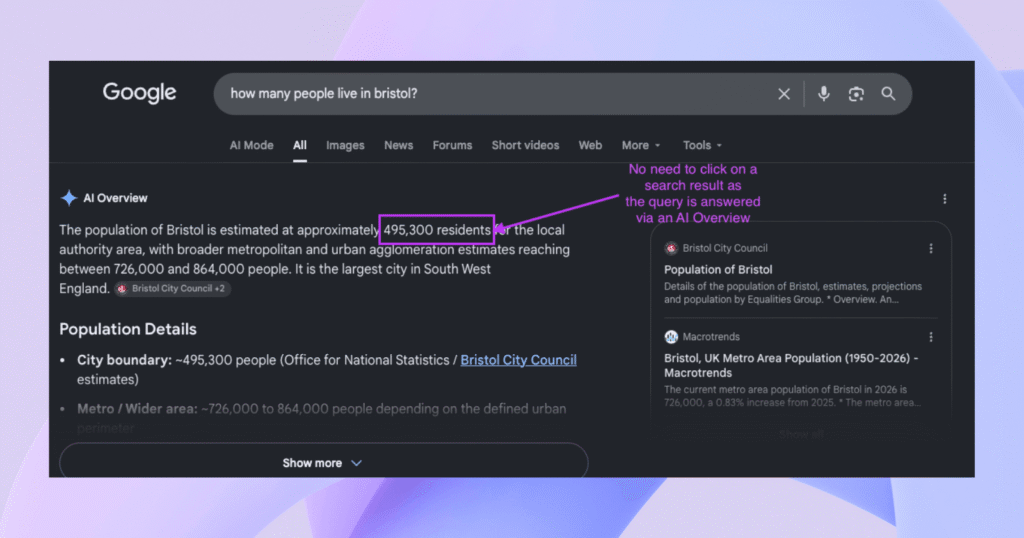
Evidence suggests buyers increasingly complete their research entirely within the AI chat window, rather than clicking on links provided by Gemini or ChatGPT. In fact, more than 68% of Google searches now result in no clicks. This bypasses so many traditional marketing touchpoints, meaning users never enter your primary sales funnel or view your on-site EEAT credentials. Therefore, if an LLM frames your organisation with neutral sentiment, potential leads will simply convert elsewhere. Demonstrating early positive sentiment to build immediate brand trust is key.
4. Thousands of reviews are condensed into one definitive answer
If you’ve ever left a detailed review you know you’re trying to communicate your personal experience as a guide for other users, rather than try to summarise that of the customers who sat at your table or spoke to the same customer service agent a week before.
Unfortunately, AI platforms condense thousands of disconnected feedback points into a definitive narrative. Summaries highlighting persistent customer support delays replace quantitative star ratings, amplifying perceived weaknesses around your brand. Because these narratives are generated instantly and appear authoritative, it can become difficult to undo perceptions around your flaws through your owned channels.
Why does this all matter? Because these are the hallmarks of the online customer experience, the shifting sands of digital browsing. You might not be able to go in and edit the AI response directly, but a concentrated strategy can begin to reign in errors and course correct.
How to build an AI sentiment strategy
Fortunately, managing your brand’s AI sentiment is not out of your control. Whether you’re a brand new brand or an existing one that wants to refine their presence online, there are some immediate changes you can make to your organic strategy to achieve an AI brand sentiment you feel reflects your business.
Re-think your content governance process
First things first, your content might need an overhaul. Adapting traditional EEAT practices for AI brand management requires a structured content governance process.
LLMs like content structured into clear factual units that can be easily digested and credited to your site without any confusion. Be clear about what your content entails and the purpose of the page. A changelog of updates can also be useful for providing LLMs with updates about your business or sector and eliminate common hallucinations.
If you can show expertise and experience behind your content, that will help to elevate it further and will contribute to building a better trustworthy connection between your brand and the user-facing content. Ultimately, writing for both human readers and machine extraction ensures your value propositions are never misinterpreted by AI algorithms.
Engage where AI actually reads
Brand authority depends entirely on active participation across the platforms AI actually scans.
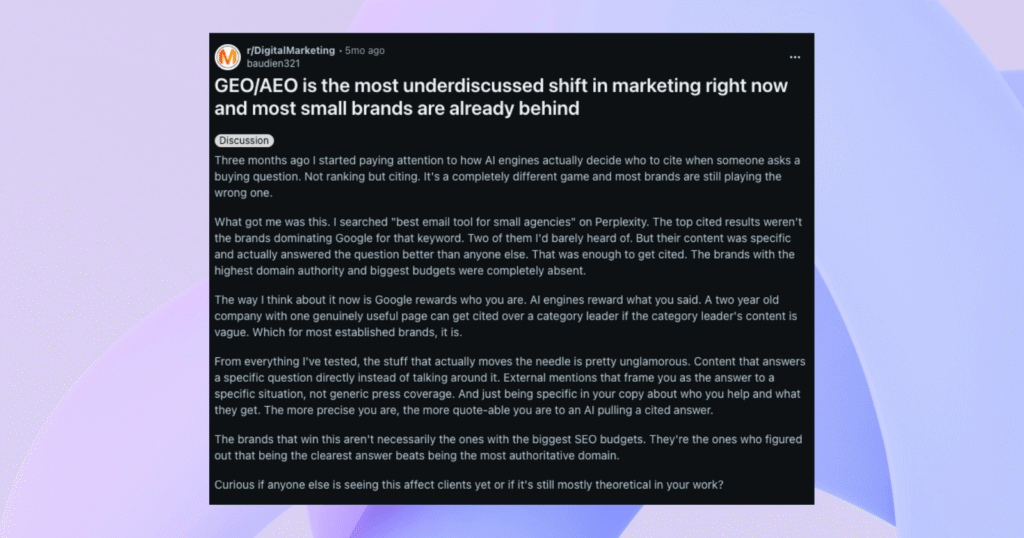
Because LLMs heavily reference third-party sources, you must engage across public forums, verified review channels and digital publications. By dominating these external spaces, you ensure the data feeding AI summaries aligns perfectly with your desired market positioning.
Be careful though, these spaces can be heavily moderated and resistant to branded content they see as free advertising. Engage in discussions naturally and become a point of reference for customer queries, rather than a faceless brand that feels impossible to reach. This is particularly the case for platforms like Reddit and LinkedIn.
Monitor, track and analyse continuously
Continuous digital monitoring is essential for maintaining a proactive AI sentiment strategy.
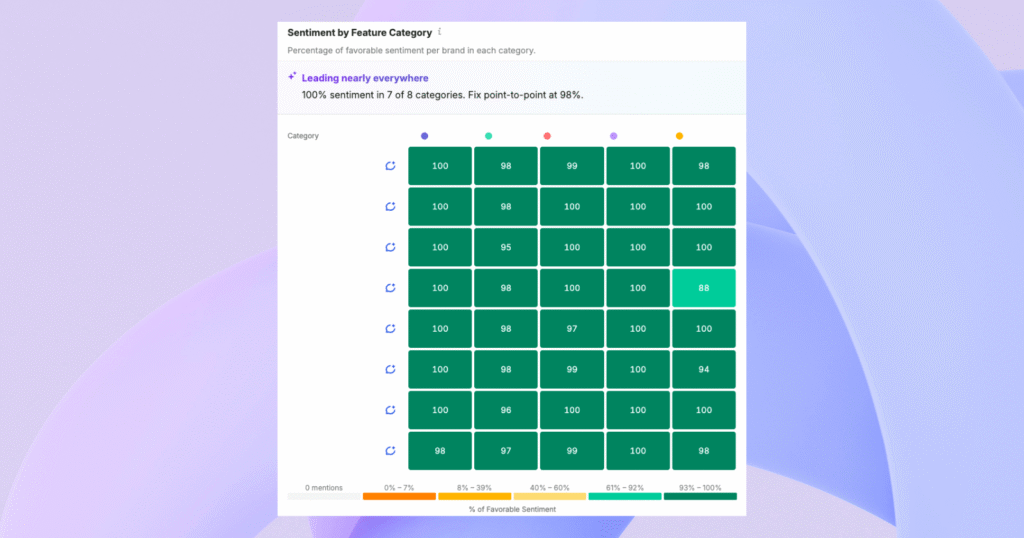
Conducting routine audits to track broad market prompts helps teams identify shifting sentiment trends and competitor positioning early. This proactive analysis allows you to mitigate emerging narratives before they become entrenched in LLM training data.
Brand sentiment analysis and optimisation is a key part of our GEO approach.
What should I do if the AI is wrong?
AI hallucinations are a common and frustrating part of the LLM experience, and can cost your brand new leads without so much as a click. Resolving false facts about your brand requires tracing the underlying web sources informing these hallucinations. From here, your strategy should look to:
- Updating outdated pages with relevant and correct information
- Creating new pages designed to address information gaps generating hallucinations of false information (for example, providing opening times for your business if they weren’t already present on your website or social accounts)
- Requesting corrections from third-party publishers and platforms
- Reduce the volume of low-value commodity content on your site
- Direct intervention and customer management of negative reviews
- An effective strategy to building positive brand presence across key UGC channels
It’s crucial to actively counter competitors who are successfully securing strong AI sentiment and positions. Strengthening external signals forces AI models to recognise your brand as the definitive authority in category comparisons.
Align your brand vision with its AI perception with Loom
Managing AI sentiment is a non-negotiable part of your GEO strategy. Brand managers now need to work backward; rather than consider the story they want to tell about their business, they need to work backwards from what AI is already saying about them.
At Loom, AI and LLM search visibility and management is embedded into our multichannel ClearThread™ strategy, where our organic SEO and data specialists work collaboratively to ensure your brand authority and market reputation remain protected. Ready to refine your digital strategy and build a positive AI sentiment for your brand?