
Complex businesses face a specific problem with organic search in 2026. The landscape has shifted with changing search engine results pages (SERPs), AI search, LLMs, zero-click results and increasingly fragmented user journeys. The tactics that worked before don’t account for the additional layer of difficulty that comes with multiple audiences, layered offers, long sales cycles and internal stakeholders who measure different things.
This guide covers what actually needs to change, and what does not.
The starting point: GEO is not a replacement
Generative Engine Optimisation (GEO) has arrived as an industry talking point with some saying it has replaced traditional SEO. It hasn’t. As Jack McGivern, Loom’s SEO & GEO specialist, puts it,
“GEO is not as far from a comprehensive SEO strategy as you might think. While GEO will leave bare-bones SEO services playing catch up, those who have continued to follow best practices will find that most of their strategies align closely with GEO best practices.”
For complex businesses, this is the right tactic. GEO is an evolution, not a reset. The businesses with solid technical foundations, genuine topical authority and consistent EEAT signals are better placed for AI search than those who start from scratch. The work compounds as long as it was done properly the first time.
What does need to change is the emphasis, the measurement model and the way organic strategy is communicated.
The 7 SEO strategies you need to succeed in 2026
So what exactly do you need to do to strengthen your organic visibility and stand out from the competition? We’ve compiled a list below, but if you’d like some help, then we’re more than happy to jump in.
1. The technical foundation matters more, not less
For a large or complex site, technical SEO is harder to maintain. Multiple stakeholders own different sections. Development priorities compete with marketing ones. Content gets added without regard for crawlability or indexation, or too much thought to the user reading it.
In 2026, that complexity has a cost. AI search engines, like traditional ones, cannot rank or cite what they cannot find and interpret cleanly.
The priorities:
- Crawlability and indexation. Confirm your robots.txt file is correct and that key pages are indexed. For AI agents specifically, a clear heading structure and accessible HTML matter more than ever.
- JavaScript dependency. There is evidence that LLMs process JavaScript-heavy pages less reliably than Google does. Reduce JS reliance where content delivery depends on it.
- Internal linking. For complex sites with deep content libraries, internal links are how crawlers and AI agents connect the dots between authority and relevance. Audit these regularly.
For complex businesses, technical SEO is not a one-off project. It requires ongoing oversight, particularly as sites grow.
2. Implement schema markup
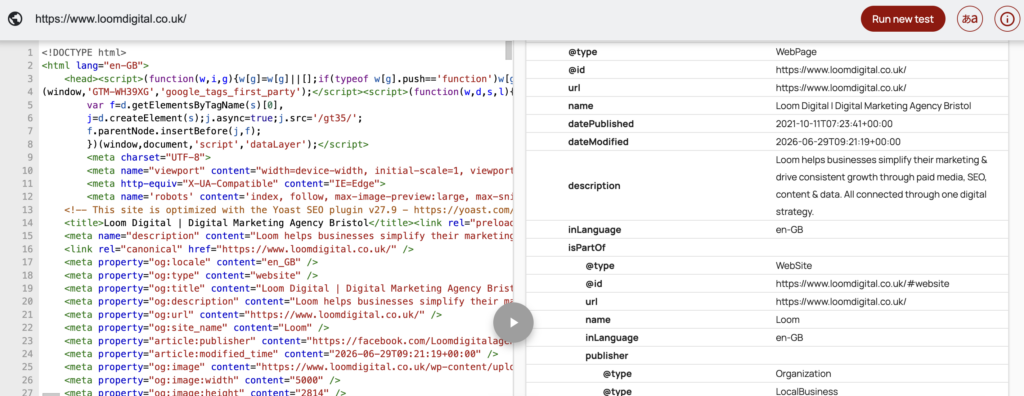
Schema (structured data) helps both traditional search engines and LLMs understand what your content is and what it is for. It clarifies whether something is a product, a service, an author or a FAQ answer and reduces the interpretive work a crawler has to do.
“Schema is helpful for search engines. Therefore, schema is good for AI visibility, even if indirectly,” says Jack McGivern.
For complex businesses with multiple service lines, locations or audience types, schema is particularly valuable. It gives search engines and AI systems a clear map of what exists on the site and who it is for.
One note: schema is a supporting signal, not a shortcut. Over-investing in it will not compensate for thin content or weak topical authority. It works when the content it supports is already strong.
3. Human expertise is your competitive advantage
AI has made it easier to produce content at volume. For complex businesses, that is both an opportunity and a risk. The risk is that internal pressure to produce more content leads to lower-quality output that risks existing authority.
The opportunity is that genuine expertise is now scarcer and more valuable.
Showcasing the experience and knowledge of your team is how complex businesses cut through. This means content that reflects real specialist insight, not summaries of what is already widely available online. It means developing author profiles with genuine credentials and providing case studies and practical guidance that only your organisation could produce.
In complex categories with niche audiences and long sales cycles, a reader’s confidence in your organisation determines whether they act. Use expert-lead content to win them over.
4. Don’t forget your EEAT signals
EEAT(experience, expertise, authority and trust) is the framework Google uses to assess content quality. In a complex business, building these signals requires coordination across teams.
The practical elements:
- Publish reviews, case studies and expert-led blog content consistently
- Keep Google Business Profile updated and accurate
- Link to authoritative external sources when referencing them
- Create author profiles that reflect the actual credentials of your team
- Feature those profiles at the end of relevant content
For businesses with multiple specialists across different disciplines, each team member’s expertise is a separate authority signal. Users want to know that they’re buying from humans who know what they’re doing.
5. Keywords have evolved and so has intent
Long-tail, conversational queries are now the default for many searchers. For complex businesses targeting niche audiences, this is not new. Your prospects have always searched with specificity. The change is that the rest of the market is catching up.
What this means in practice:
- Focus on answering the specific questions your audiences are actually asking, not on ranking for broad category terms
- Summarise key answers early in the content, rather than burying them
- Avoid over-optimisation. Crawlers are increasingly able to identify content written for SEO rather than for a reader
- Prioritise search intent over volume data, particularly for AI-generated prompt tracking tools, where volume figures are estimates at best
“Tracking prompts is vital for understanding your AI visibility. But keep in mind that any volume data you can track is an estimate, as each prompt will be highly personalised and specific to the user. You can still use this data for ideation and understanding your audience’s concerns, but always take it with a pinch of salt.” Jack McGivern.
6. Measure what actually matters
Zero-click searches have made traffic a challenging primary metric. For complex businesses, where reporting often goes to senior stakeholders with limited marketing context, this creates a communication problem as much as a measurement one. The shift is from traffic-first to visibility-first.
Alongside sessions and conversions, the metrics that matter in 2026:
- Impressions: pointing to AI Overviews, People Also Ask and other SERP features
- LLM traffic: tracked via the new AI Assistant channel in Default Channel Group reports in GA4
- AI prompt performance: where your brand is being cited and for which topics
- Engagement rate and time on site: indicators of content quality and audience fit
- Conversion data: AI search traffic tends to convert at a higher rate, as users arrive further along the decision journey
“This is an industry-wide change, and focusing on traffic or clicks is an easy way to cause panic. Make sure you are paying attention to the bottom line. Even if your traffic is down 40% this month, how many people decided to call, fill out a booking form, or purchase products?” Jack McGivern.
For complex businesses, we tailor reporting frameworks to reflect this shift, building out models that measure brand citation inside AI search alongside traditional performance data.
7. Don’t try and trick the algorithm
The principles that have always governed good SEO practice apply with equal force in 2026. Keyword stuffing, manipulative link-building and AI-generated content without genuine expert input are risks.
The cleaner version of this is also the more strategic one: write for the person, not the algorithm. Ensure your site is crawlable, your content is indexed, your heading structure is clear, and your pages provide something a reader could not find elsewhere.
For complex businesses, the temptation to produce at volume to cover multiple audience segments is understandable. The better approach is fewer, deeper pieces that demonstrate genuine authority across the topics that matter to your audiences.
What is the future of SEO?
SEO has always rewarded the organisations that build something worth finding. GEO extends that principle into AI search. For complex businesses with genuine expertise, layered audiences and a long-term view of growth, the fundamentals have not changed. The emphasis has.
“AI will create a cycle that disincentivises original research. If AI can cite your research in under a second and pass it off as its own, soon AI may not have as much solid research to take inspiration from. This could become a compounding problem if AI starts to cite other AI articles over time.” Jack McGivern
The businesses that invest in genuine expertise now are building an asset that becomes harder to replicate, not easier.
To explore how Loom builds connected organic strategies for complex businesses, read about our SEO and Content services or get in touch.